
 26/10/2026
Choosing between an HDB flat and a condominium in Singapore is about more than finding a place to sleep. You want a comfortable home, a convenient location and enough money left for food, transport, savings and family needs. But which option gives you better value?
For Singaporeans waiting for their BTO flat, couples setting up a home, and professionals moving closer to work, rental costs can strain monthly budgets. Foreign professionals must also consider eligibility rules and moving expenses. The best choice depends on your total housing costs, not just the advertised rent. Let’s compare HDB flat vs condo rental in Singapore so you can make a practical decision without stretching your finances.
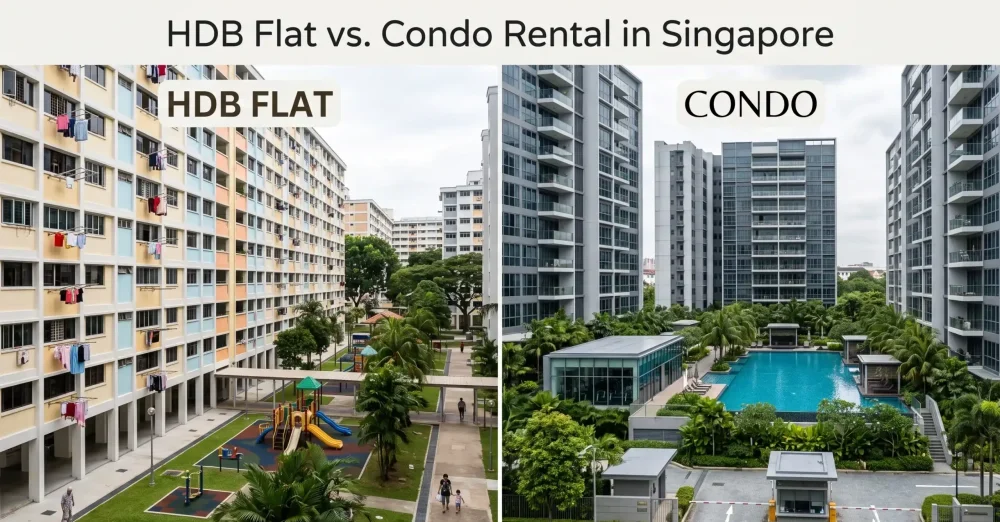
HDB Flat vs. Condo Rental in Singapore
HDB flats are public housing units, while condominiums are private residential properties. Both can offer comfortable living, but their prices, facilities and rental conditions differ. Singapore’s housing supply has continued to expand, although rental prices still vary by neighbourhood, property size and demand. A home near an MRT station or business district may cost more than a similar property farther away.
HDB flats often appeal to renters who value space and everyday convenience. Condominiums may suit those who prefer shared facilities, controlled access and particular locations. Neither option is automatically better. Your household size, income, lifestyle and rental period should guide your decision.
How Much Does It Cost to Rent an HDB Flat vs. a Condo in Singapore?
Typical Monthly Rental Prices by Property Type and Location
Monthly rent is usually the biggest housing expense. HDB flats may offer more space for the price, while condominiums can cost more because of their location, design and facilities. Singapore’s private residential market is divided into three regions: Outside Central Region (OCR), Rest of Central Region (RCR) and Core Central Region (CCR). Central locations can be more expensive, but prices also depend on the property’s condition, size and distance from transport links.
Use this table to compare the main factors before reviewing current listings.
| Rental factor | HDB flat | Condominium |
|---|---|---|
| Whole-unit rent | Often offers practical space at a lower cost | May cost more for facilities or location |
| Room rental | Can suit tenants on tighter budgets | Provides another shared accommodation option |
| Location | Many estates have shops and public transport nearby | Options range from suburban to central areas |
| Facilities | Depends on the block and neighbourhood | May include a gym, pool and security |
| Layout | Often practical for families | Varies by development and unit type |
For current comparisons, check HDB rental statistics alongside recent private property listings. Compare similar properties in the same area rather than relying on broad averages.
Which Property Offers More Space for Your Money?
If you need extra bedrooms or more living space, an HDB flat may offer better value. This can matter to families, couples working from home and tenants who need storage. Condominiums may offer smaller private units alongside shared facilities. These can be useful if you regularly use the gym or swimming pool, but less valuable if you rarely use them. Compare the floor plan, storage, room sizes and furniture layout. Price per square foot is useful, but it does not show how comfortable a property will feel in everyday life.
HDB vs. Condo Rental: A Quick Cost Comparison
| Your priority | Option to explore |
|---|---|
| More living space for your rent | HDB flat |
| Lower costs through shared accommodation | HDB or condo room |
| Private shared facilities | Condominium |
| Access to heartland shops and food centres | HDB flat |
| Short commute to a specific workplace | Compare both nearby |
These are starting points, not guarantees. A well-located condominium may suit you better than an HDB flat in a less convenient area. Always compare the complete cost before deciding.
What Hidden Costs Should You Budget for When Renting in Singapore?
Security Deposits and Other Upfront Expenses
Your first rental payment may be much higher than one month’s rent. You may need to pay a security deposit, advance rent, stamp duty and moving costs before receiving your keys. A deposit equal to one month’s rent for a one-year lease or two months’ rent for a two-year lease is common practice, but the agreed terms can differ.
For example, if your monthly rent is S$3,000 and the landlord requires a two-month deposit, you need S$6,000. Add the first month’s rent, and the initial payment reaches S$9,000 before moving expenses and stamp duty. Read the tenancy agreement to understand when the deposit will be returned and what deductions may apply. This is especially important if you are moving out of your current home while waiting for your BTO flat.
How Much Is Rental Stamp Duty in Singapore?
Rental agreements are generally subject to stamp duty under Inland Revenue Authority of Singapore (IRAS) rules. For leases of four years or less, the duty is generally 0.4% of the total rent for the lease period, subject to the applicable rules.
Consider this example:
| Item | Amount |
|---|---|
| Monthly rent | S$5,000 |
| Lease period | 12 months |
| Total rent | S$60,000 |
| Stamp duty | S$240 |
This example assumes the duty is calculated on the stated rent alone. Additional payments may affect the calculation.
Utilities, Air-Conditioning, and Maintenance Costs
Rent is only one part of your monthly housing bill. Electricity, water, internet and air-conditioning use can all add to your spending. Singapore’s warm climate means air-conditioning may be a regular expense. Your actual bill will depend on how often you use it, the number of occupants, and the equipment’s efficiency. Do not assume every condo costs more to cool than every HDB flat.
Check the tenancy agreement for air-conditioning servicing requirements and repair responsibilities. Some landlords require tenants to arrange regular servicing, while others may have different terms. Condominium management fees are generally paid by the owner, but tenants may be responsible for damage or certain repairs under the agreement. Before signing, ask what is included in the rent and which expenses you must pay separately. Clear terms can help you avoid unexpected costs later.
What Are the HDB and Condo Rental Rules in Singapore?
Can Foreigners Rent an HDB Flat in Singapore?
Yes, eligible foreigners can rent HDB flats, provided they meet the relevant immigration and HDB requirements. However, tenants should confirm eligibility before paying a deposit. The Non-Citizen Quota applies to whole-flat rentals involving non-Malaysian non-citizens. It is capped at 8% at neighbourhood level and 11% at block level. Malaysian citizens are excluded from this quota, and it does not apply to bedroom rentals. Foreign tenants should check the flat’s eligibility, confirm the landlord’s approval and ensure that all intended occupants meet the relevant requirements.
What Are the Minimum Rental Periods and Occupancy Limits?
HDB flats generally require a minimum rental period of six consecutive months. Private residential properties have a minimum stay of three consecutive months, so short-term daily or weekly residential rentals are not permitted under the standard rules.
Occupancy limits also depend on the property type, size and applicable regulations. Temporary relaxations may affect the maximum number of occupants allowed in eligible properties, so do not rely on outdated online listings.
What Should You Check Before Signing a Tenancy Agreement?
Your tenancy agreement should clearly state the rent, lease dates, deposit, payment schedule and responsibility for repairs. Inspect the property and record any existing damage before moving in. If a property agent is involved, verify their details through the Council for Estate Agencies (CEA) Public Register. Avoid paying money simply to secure a viewing, and make sure payment arrangements are verifiable. These steps help protect your deposit and reduce the risk of disputes during the tenancy.
HDB vs. Condo: Which Offers a Better Lifestyle for Your Money?
Why HDB Flats Appeal to Budget-Conscious Renters
Many HDB estates offer convenient access to MRT stations, bus services, hawker centres, supermarkets and neighbourhood shops. These everyday amenities can make life easier without requiring long journeys.
For Singaporean households, nearby food centres and local shops may offer more practical value than facilities they rarely use. Families may also appreciate a larger layout, while couples waiting for BTO completion may prefer a comfortable temporary home without paying extra for unnecessary features. However, convenience depends on the individual estate. Check the property’s condition, transport links and distance from the places you visit regularly before deciding.
What Extra Benefits Do Condominiums Offer?
Depending on the development, condominiums may provide swimming pools, gyms, tennis courts, BBQ areas and controlled access. These facilities can improve everyday convenience, especially if you use them regularly. For example, an on-site gym might reduce the need for a separate membership. But if you prefer exercising outdoors, that feature may not justify a higher rent.
Some condominiums are also close to business districts, international schools and major transport links. For professionals with demanding schedules, a shorter commute may be worth the additional expense. The key is to pay for benefits you will actually use, not simply those that look attractive during a property viewing.
How Does Location Affect Your Total Housing Budget?
A cheaper property may be farther from work, school or family support. Extra commuting time and transport expenses can reduce the savings you gain from lower rent. Compare your likely weekly routine, including journeys to work, grocery shopping and school. Consider whether you will need private-hire rides when public transport is inconvenient. A centrally located condo may be worthwhile if it saves considerable travel time. Equally, an HDB flat near an MRT station can offer a strong balance between convenience and affordability. The best location fits your routine without putting unnecessary pressure on your budget.
Which Rental Option Fits Your Budget and Household Needs?
If Your Budget Is Below S$3,000 a Month
Start by deciding whether you need an entire home or can share accommodation. Depending on the location and property size, an HDB flat or a rented room may be more practical than a whole condominium unit. Remember to leave money for food, transport, utilities and savings. If rent takes up too much of your income, consider a different neighbourhood or a smaller property.
If Your Budget Is S$3,000–S$3,500 a Month
Compare larger HDB options with smaller condominiums. Think about whether extra facilities or a shorter commute justify paying more. Couples waiting for BTO completion should also consider their expected waiting period. Choose a lease that suits your plans while meeting the applicable minimum rental requirements.
If Your Budget Exceeds S$3,500 a Month
A higher budget may offer more choices, but spending the maximum is not always wise. Compare larger HDB flats and condominiums based on space, location and the facilities you will use. Keeping rent below your maximum can free up money for savings, family needs and unexpected expenses.
Which Property Type Suits Singles, Couples, Families, and Expats?
Singles may prioritise affordability and commuting convenience. Couples may want privacy while waiting for their BTO flat. Families often need more bedrooms, storage and access to schools and everyday services. Expatriates may value furnished units and proximity to work, but must check the relevant rental eligibility rules.
Use these questions to narrow your options:
- Do you need more space? Start with HDB flats and compare layouts.
- Will you use private facilities regularly? Consider whether a condo’s extra rent is worth it.
- Is location your main priority? Compare travel times and transport costs for both property types.
How Can You Make Renting More Affordable Without Sacrificing Your Priorities?
Use the 30% Rule as a Starting Point
A common budgeting guideline is to keep rent around 30% of gross household monthly income. This is a rule of thumb, not a government requirement or a guarantee of affordability. For example, a household earning S$6,000 a month before deductions would allocate S$1,800 to rent using this benchmark. However, the household must still cover food, transport, insurance and other commitments. If you support family members or have high monthly expenses, choosing a lower rent may be more sensible. Your budget should reflect the money you actually have available after essential costs.
Plan for Upfront Costs Without Draining Your Savings
Calculate the deposit, advance rent, stamp duty and moving expenses before committing. Keep an emergency reserve for unexpected bills or income changes. If you need help managing a temporary cash-flow gap, consider all costs before borrowing. Interest and repayments will add to your monthly commitments.
Protect Yourself Against Rental Scams
Rental scams can turn an affordable-looking property into a costly mistake. Take these precautions before transferring money.
- Verify the agent: Check their details through the CEA Public Register.
- Confirm the property: View the home and verify the landlord’s authority to rent it out.
- Keep payment records: Use verifiable payment methods and retain receipts and signed agreements.
If anything seems suspicious, pause and verify the details before proceeding.
Choosing Between an HDB Flat and a Condo
HDB flats may offer better value for renters who prioritise affordability, practical amenities and living space, while condominiums may appeal to those who prefer private facilities, security features or a convenient location. Before deciding, compare the total cost of renting, including deposits, stamp duty where applicable, utilities, transport, and other housing-related expenses.
Check the applicable rental regulations and choose a property that suits your household size, lifestyle and budget. If upfront rental costs or moving expenses strain your finances, Capital Funds Investments (CFI) offers financing solutions, including rental loans, for eligible borrowers who need help managing rental-related expenses. Before applying, review the interest rates, fees, repayment terms and your ability to make repayments comfortably.
Whether you choose an HDB flat or a condominium, prioritise a rental arrangement that supports your financial stability. Careful budgeting, adequate emergency savings and responsible borrowing can help you secure a suitable home without compromising your long-term financial goals.
Related Blogs
 12/10/2026
How Much Does It Cost to Raise a Child in Singapore?
How Much Does It Cost to Raise a Child in Singapore? Raising a child in Singapore brings plenty of joy,...
Continue Reading
 22/09/2026
The Ultimate Financial Setup Guide for Expats Moving to Singapore
Moving to Singapore is exciting, but the financial side can feel like a lot at once. A new home, salary,...
Continue Reading